Revenue-stamped house/land papers with NRC booklet
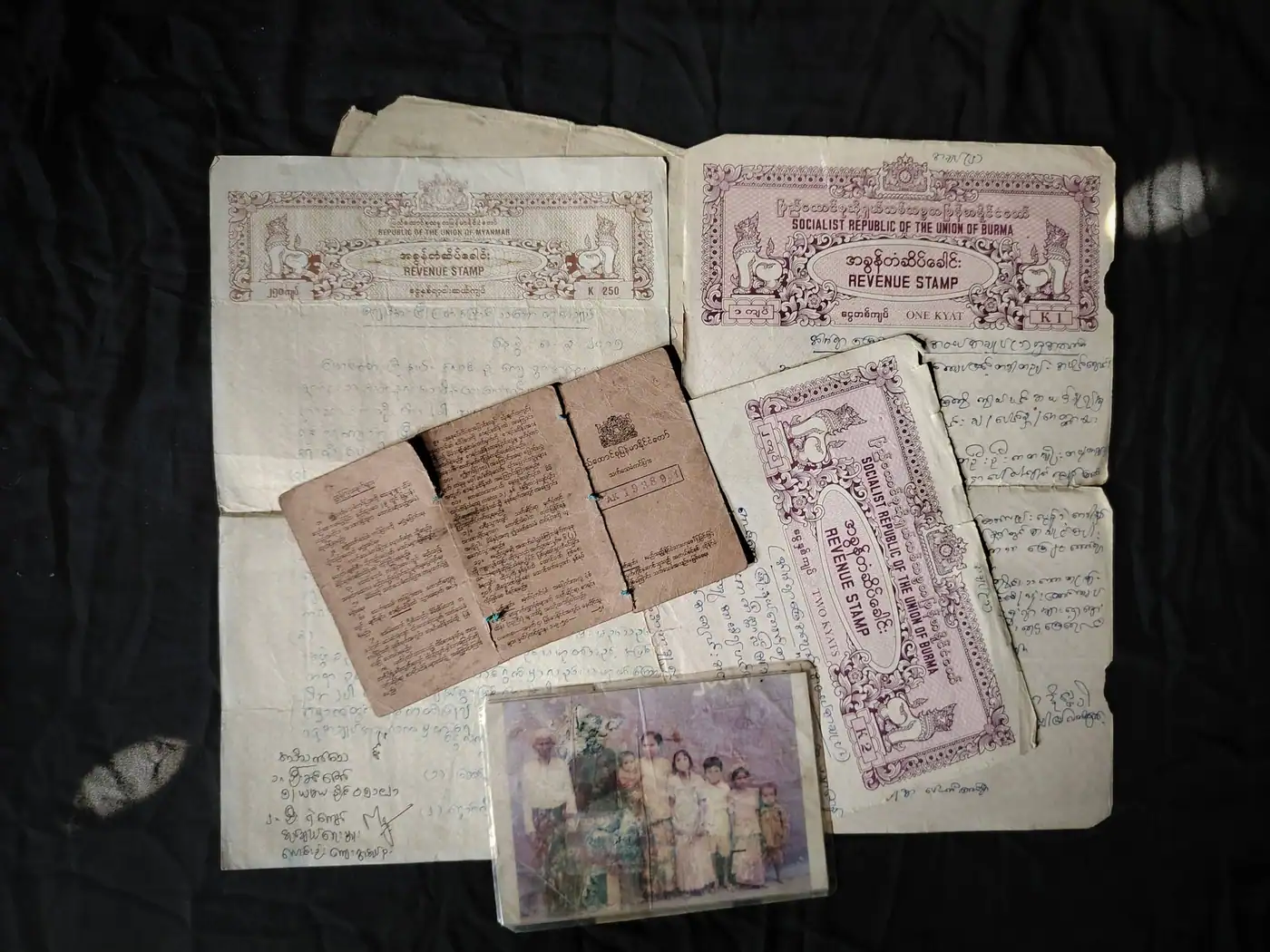
Handwritten Burmese documents on revenue-stamp paper (Republic of the Union of Myanmar K250; Socialist Republic of the Union of Burma K1 and K2), described in the caption as papers about the family home, with an old identity card booklet and a family photo laid on top.
About this document
- Category
- Land & Property
- Script
- Burmese
- Place
- Maungdaw Township
- Photographed by
- Rouda Sharmin
- Shared on
- 20 October 2026
From the collection
Preserving a Family’s History Through Documents Dildara Begum, 43, is a Rohingya woman born in Longdun Mya Zanpur Village, Maungdaw Township, Rakhine State (Arakan), Myanmar. Her life has been marked by displacement, loss, and the struggle to preserve her family’s identity and connection to their homeland. For Dildara, Myanmar is more than the place where she was born and raised. It is the land where her family built their lives, where memories were made, and where generations of her family once lived. Although she was forced to flee, her connection to that home remains deeply rooted in her memories. When Dildara fled to Bangladesh during the genocide, she made sure to bring important family documents, including her mother's AK card, her son’s school ID card, and papers related to their home in Myanmar. Amid the uncertainty of displacement, these documents were among the important records she carried with her, preserving evidence of her family’s identity, her son’s education, and the home they had left behind. Today, Dildara carefully keeps these documents as a record of her family’s past. Each document holds a different part of their history, recalling the lives they lived before displacement and the connection they continue to maintain with their homeland. She hopes to show them to her grandchildren so they can learn about their family’s origins and understand the history of the generations before them. For Dildara, preserving these documents is a way of keeping her family’s history alive. Though years of displacement have separated her family from their homeland, she continues to safeguard the records that connect her children and grandchildren to the place their family once called home. Rouda Sharmin
Photograph by Rouda Sharmin, first shared by the Rohingya Photographic Society.